






Responsibility
Sun protection with heart
For us, sun protection means more than just reliable UV protection. That is why, when developing our formulas, we consider the impact that sunscreen products can have on coral. When selecting our UV filters, we deliberately avoid oxybenzone, octinoxate, and octocrylene, the potential effects of which on marine organisms are being scientifically studied and discussed.
But we didn't want to look only at individual ingredients. That is why we had specific V.SUN sun protection formulas scientifically tested for possible short-term effects on various coral species. You can find out more about the studies, the tested coral species, and the specific results in the next section.
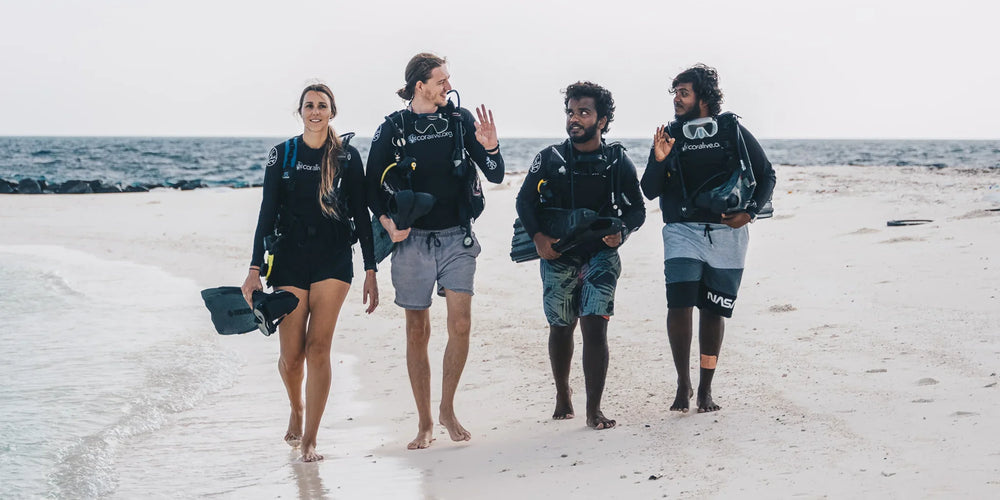
Protecting coral and the oceans is a matter close to our hearts. In addition to deliberately avoiding octocrylene, oxybenzone, and octinoxate, we are also actively involved in coral conservation. Since the brand was founded in 2020, we have supported the non-profit organization coralive.org with over 100,000 euros. This organization is involved in numerous projects worldwide for the restoration of coastal ecosystems and is dedicated to various coral reforestation projects, for example in the Maldives and Madagascar.
With this, we want to make a tangible contribution to preserving these sensitive habitats for future generations and to highlight their special importance for our oceans. Our goal is to make specific measures transparent instead of making blanket environmental promises.
How do corals react to our sunscreen?
As early as the product development stage, we had our base formula with the highest sun protection factor, SPF 50, tested by the independent institute HelioScience in Marseille. In this 96-hour test, the stony coral Seriatopora hystrix, among others, was examined. Under the test conditions, no acute negative effects were observed for the parameters investigated.
A further scientific study was conducted in collaboration with the University of Bremen (Marine Ecology). For this purpose, controlled tank experiments were carried out in 2024 in the Maldives using native coral species. The stony corals Acropora digitifera, Pocillopora verrucosa, and Porites lobata, as well as the soft coral Sarcophyton, were examined. The corals were exposed to a defined concentration of various sunscreen products over a period of 96 hours.
The result for the tested V.SUN Face SPF 50 formula: Under the conditions of the study, no tissue loss was detected; depending on the parameter, the examined corals showed no or only minor changes. In a direct comparison, two sunscreens from other manufacturers were tested alongside the V.SUN formula. While signs of coral bleaching were observed in both comparison products, these did not occur with the tested V.SUN formula.*
For us, such studies are an important part of the further development of our products. Therefore, we continue to follow scientific research on sunscreen and marine ecosystems and incorporate new findings into our product development.
Coral studies instead of advertising promises
For us, the scientific investigation of our formulas is at the heart of what we do – from the selection of ingredients to independent testing. It is a standard that we consistently pursue, from the selection of ingredients and the development of the formula through to scientific verification.
*Selected V.SUN sunscreen formulations were tested in independent 96-hour studies on the stony coral species Seriatopora hystrix, Montipora digitata, Acropora digitifera, and Pocillopora verrucosa. Under the respective test conditions, no significant adverse changes in the examined coral physiological parameters were detected for the V.SUN formulations; in particular, no tissue loss or mortality caused by V.SUN occurred. Basis: Helioscience (2020)
Carefully developed formulations
Our sun protection products combine reliable UVA and UVB protection with select skincare active ingredients. The blend of carefully selected modern UV filters ensures reliable protection while allowing for pleasantly light textures.
Depending on the product, selected skincare active ingredients complement our sun protection formulations: Niacinamide supports the natural skin barrier and can contribute to a more even complexion. Ectoin helps protect the skin from environmental stressors and supports its natural protective function. Hyaluronic acid binds moisture and helps to hydrate the skin and keep it supple. You can find out transparently which of these active ingredients are contained in which V.SUN product on the respective product page. During development, we consciously avoid oxybenzone, octinoxate, and octocrylene, as well as solid synthetic microplastic particles and UV filters in nano form. All V.SUN sun protection products are vegan.
The skin tolerance of our products has been dermatologically tested. Selected products from our sensitive range are also suitable for children aged 3 and over.
Our packaging: Developed step by step
We are also constantly looking at how to improve material usage, design, and recyclability when it comes to our packaging. For example, the material of our tube bodies is recyclable and made from reusable PCR plastic.
In addition, V.SUN collaborates with CleanHub . Since V.SUN was founded, we have supported the collection of plastic waste in regions without adequate waste infrastructure through this partnership. As a result, we have already been able to collect up to 28,000 kg since 2020.
Our Partnerships
At V.SUN, we believe that effective engagement is primarily the result of long-term collaboration. That is why we deliberately focus on partnerships with organizations and service providers with whom we support concrete projects over an extended period and accompany their development.
Since our founding in 2020, we have been committed to the protection and restoration of coral reefs and coastal ecosystems together with coralive.org. The organization implements coral reforestation projects worldwide and contributes to the long-term preservation and restoration of coral reefs and their associated habitats.
Together with CleanHub, we contribute to the collection of plastic waste in regions with inadequate waste infrastructure. By providing financial support for the collection and recycling of plastic waste, we foster projects that help reduce the risk of plastic waste entering the environment uncontrollably and, consequently, our rivers and oceans.
Our partnerships are designed for the long term: We do not just want to support isolated measures, but rather work together with experienced partners to permanently accompany and further develop concrete projects.